Wednesday, June 29, 2011

Saturday, May 28, 2011
Palestra na PUC RJ
Comunicação de Risco - .:. Portal PUC-Rio Digital .:.
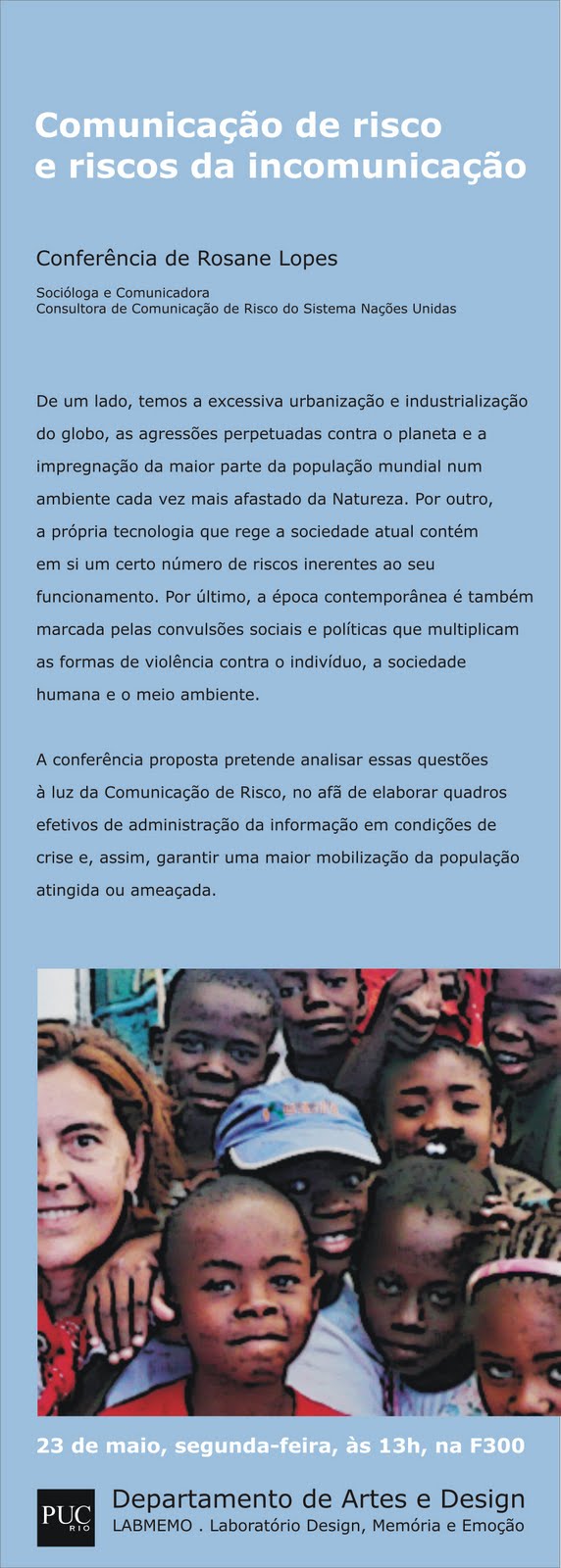
O Deparatamento de Artes e Design da PUC-Rio organizou na tarde do dia 23 de maio, no auditório 300-F, a Conferência "Comunicação de risco e risco da Incomunicação

O Deparatamento de Artes e Design da PUC-Rio organizou na tarde do dia 23 de maio, no auditório 300-F, a Conferência "Comunicação de risco e risco da Incomunicação

Wednesday, May 25, 2011


Thursday, April 7, 2011
Comunicação de Risco e Risco da Incomunicação - Caso Japão
Poor risk communication in Japan is making the risk much worse
The radiation crisis in Japan worsens for two reasons: one that we’ve heard about, one that we haven’t but which may in the end do far more harm. The Japanese government, and the company in charge of the crippled nuclear complex, are struggling with their risk and crisis communications, and their missteps are fueling mistrust and anger, which magnifies fear and stress, which may do more health damage than the radiation itself.
Some efforts have been outstanding. The constant presence of Chief Cabinet Secretary Yukio Edano, providing updates several times an hour, dressed in the work clothes of an emergency responder, not the suit and tie of a bureaucrat, and responding to questions without a script and with concern, has been very important. But Tokyo Electric’s (TEPCO) apology, days into the crisis, even though made by company President Masataka Shimizu, seemed insincere against news that the company had to be ordered by Prime Minister Naoto Kan to keep it’s workers at the site, despite radiation danger, to try to bring the nuclear reactors under control. Further, it took four days for the government and TEPCO to coordinate communications, and the disjointed and incomplete information released in those first few critical days created grave mistrust in both the company and the government. Edano himself said yesterday "In hindsight, we could have moved a little quicker in assessing the situation and coordinating all that information and provided it faster."
It is impossible and unfair to criticize specifics. At this distance it is hard to know exactly how things are playing out, what’s being said, and harder still given that a lot is lost in translation. We also must respectfully remember this is an extraordinary crisis, with profound changes happening minute-by-minute, and the people fighting the fires can’t stop what they’re doing to pick up the phone and update headquarters on the latest developments moment-by-moment.
But it is clear than not nearly enough attention has been given to the importance of risk communication as a key part of managing the overall risk from these events. And that bears squarely on the health and safety of the public. Risk management in a crisis has to include not just the threat itself but also how people perceive and respond to the threat. Risk communication is a vital tool; for managing that part of the overall risk. How would you feel if messages about possible danger are inconsistent, and you learn things from the press that the government or company knew but didn’t tell you?
How does it feel when the Japanese government says radiation levels outside the plant are low and safe but experts from around the world sound more worried, or when the head of the IAEA, Yukiya Amano, has to scold the Japanese government by publicly asking them to share more information with the IAEA itself. How does it feel to know that TEPCO, and to a lesser degree the government, has a history of being less than forthright and open about problems at other nuclear facilities? Press reports have revealed that the company has frequently been purposefully deceitful about nuclear problems at other sites in the past. See "Japan Disaster Caps Decades of Faked Reports, Accidents". Stunningly, all these mistakes have been made in a country which has the most horrific first-hand experience with the frightening risks of radiation, albeit two generations ago, in Hiroshima and Nagasaki.
In a word, that sort of poor risk communication will make you feel mistrustful. And mistrust in the people who are supposed to keep you safe translates into anger and worry, which causes all sorts of serious health risks. The likelihood of Post Traumatic Stress disorder, depression, and anxiety goes way up. Biologically, fear produces chronic stress, which increases blood pressure and raises the risk of cardiovascular disease, suppresses the immune system and raises susceptibility to and severity of infectious disease, increases the likelihood of Type 2 diabetes, suppresses growth, memory, and fertility. The risk from how people perceive risk, is as real as the physical danger itself, perhaps more.
We know that from previous nuclear crises. In "Chernobyl’s Legacy", a sweeping review of Chernobyl at the 20th anniversary in 2006, the UN found that "The mental health impact of Chernobyl is the largest public health problem unleashed by the accident to date." In a review of how the government handled Three Mile Island, a senior Nuclear Regulatory Commission official who had been involved said of the poor communication "What we had done to these people was just outrageous. We had frightened them so bad, they thought they were going to die." Stunningly, tragically, a similar inattention to effective risk communication seems to be happening in Japan.
A NY Times story "Radiation Fears and Distrust Push Thousand From Homes" quoted a citizen who fled his home, which was outside the mandated evacuation zone, "We might be overreacting, but we also know Tokyo Electric" — the plants’ operator — "is not telling us everything," and reported that another ,"Hitoshi Suzuki, a 34-year-old construction worker, said that he thought the problem at the nuclear plants was twice as bad as the government let on. He produced a cellphone with Web sites that claimed the government was covering up the real damage at the plants."
A Bloomberg news story "Conflicting Information Drives Anxiety in Japan Nuclear Crisis" quoted another citizen saying "We’re furious about a lack of information from both the government and TEPCO. We also noticed there are conflicting accounts from the parties. Foreign media is reporting the impact of the nuke accident would be disastrous while Japanese media play it down. The gap also urged us to leave."
A New York Times article "Dearth of Candor from Japan’s Leadership said "…an increasingly angry and rattled Japanese public (is) frustrated by government and power company officials’ failure to communicate clearly and promptly about the nuclear crisis. Pointing to conflicting reports, ambiguous language and a constant refusal to confirm the most basic facts, they suspect officials of withholding or fudging crucial information about the risks posed by the ravaged Daiichi plant." There is "…a lot of frustration among the public…demanding government to be more forthcoming. Not knowing is their biggest fear." (my emphasis)
There are many reasons for this poor risk communication; Arrogance and institutional self-protection and engineering/scientific hubris on the part of the company, the tendency by risk managers to avoid being honest with people about scary news for fear that it will make people afraid (which is a common but thoughtless mistake, since people are already afraid and the lack of openness and the mistrust it produces make things FAR worse), and a combative/defensive relationship with an aggressive, alarmist news media.
But the biggest mistake is an obvious failure to recognize that risk communication is a vital part of overall risk management. Far too little respect has been paid to the risk caused by the way people perceive and respond to risk. The peril is not just the radiation. It’s people’s fears of radiation. Whether those fears are consistent with the evidence of the actual physical risk (they aren’t) doesn’t matter. Fear is real, and does real harm. Tragically, though history has taught us these lessons, they don’t appear to have been learned, and the health of the Japanese public is at risk as a result.
Published in: Scientificamerican.com.
Monday, March 21, 2011 |
http://www.scientificamerican.com/blog/post.cfm?id=poor-risk-communication-in-japan-is-2011-03-19
Sunday, February 6, 2011
Meio Ambiente e Comunicação de Risco
A problemática da Comunicação de Risco é composta por várias camadas conceituais. Num primeiro nível, temos o aspecto filosófico e seu teor ontológico e subjetivo da transição da linear idéia de Fortuna para o complexo conceito de Risco. E, por conseqüência, temos também as implicações desta transição sobre o novo sujeito ocidental moderno, sua percepção do meio ambiente, suas concepções morais e éticas e suas atitudes sociais e políticas.
Em seguida, há o aumento real de fatores de risco em decorrência das mudanças introduzidas pela modernidade. De um lado, temos a excessiva urbanização e industrialização do globo, as agressões perpetuadas contra o planeta e a impregnação da maior parte da população mundial num ambiente cada vez mais afastado da Natureza. Por outro lado, a própria tecnologia que rege a sociedade moderna contem em si um certo número de riscos inerentes ao seu funcionamento. Por último, a época moderna é também marcada pelas convulsões sociais e políticas que multiplicam as formas de violência contra o indivíduo, a sociedade humana e o meio ambiente.
Porém, ainda que não se ignore a veracidade dessas incertezas constitutivas da modernidade ocidental, é imperativo não se esquecer da perspectiva crítica que questiona o significado político e ideológico das representações e discursos midiáticos sobre o Risco.
A Comunicação proposta pretende analisar essas questões à luz da Comunicação Ambiental, no afã de elaborar quadros efetivos de administração da informação em condições de crise e, assim, garantir uma maior mobilização da população atingida ou ameaçada.
Wednesday, January 12, 2011

Sunday, December 12, 2010
Noticia da Força de Paz no Haiti
Últimas noticias - combate contra cólera
uma história comovente..
uma história comovente..
BRABATT 2 reforça Batalhão Argentino durante as eleições | |
Porto Príncipe (Haiti) – Durante as eleições, o BRABATT 2 reforçou o Batalhão Argentino na missão de garantia da segurança para a realização do pleito eleitoral e transporte de urnas. O apoio teve início, no dia 22 de novembro, com o deslocamento de um pelotão mecanizado para Gonaives. Em 29 de novembro, uma companhia do BRABATT 2, compondo a reserva da MINUSTAH como Força de Reação Rápida (QRF), foi enviada para Saint Marc. Na região central do Haiti, 120 militares atuaram na desobstrução de vias, na escolta de material eleitoral e no controle de manifestações. Em uma delas, no contato iminente, uma turba iniciou o canto do hino do Haiti que foi acompanhado pelos militares brasileiros. Esse fato fez com que a tropa ganhasse a simpatia do grupo de haitianos, que recuaram pacificamente. Fonte site Exercito |
Friday, December 10, 2010
Monday, November 29, 2010
Gaúcha participa de ajuda humanitária no Haiti
Haitianos ainda têm dúvidas sobre como se contrai o cólera
A situação de emergência que o Haiti vive desde o terremoto de 12 de janeiro, que matou cerca de 250 mil pessoas, se agravou ainda mais com a passagem do furacão “Tomas” e com a epidemia do cólera. A gaúcha Rosane Lopes trabalha para a Organização Mundial da Saúde (OMS) e esta é a quinta vez que ela visita o país caribenho, conhecido por depender de ajudas humanitárias. De acordo com Rosane, ainda há muitas dúvidas por parte dos haitianos quanto ao contágio pelo cólera. Um exemplo é Martinè Dufount, moradora de Porto Príncipe, que não sabe como se contrai a doença. Mais de 25 mil pessoas estão sendo tratadas em hospitais por terem registado sintomas da doença. O Banco Mundial anunciou um empréstimo de 10 milhões de dólares, mas a escassez no país vai desde o sabão aos sacos para colocar os cadáveres, que aumentam a toda hora. Cuba já enviou 400 médicos ao Haiti para ajudar as pessoas com sintomas do cólera. A Organização das Nações Unidas (ONU) espera que outros países e organizações contribuam diante da perspectiva de que centenas de milhares de haitianos sejam infectados. Fonte Correio do Povo - 29 nov 2010. |
Sunday, November 7, 2010


Friday, November 5, 2010
Monday, November 1, 2010
Saturday, October 23, 2010
La OPS responde al brote de cólera en Haití
La Organización Panamericana de la Salud informó hoy que ha recibido la confirmación de laboratorio de los casos de cólera en Haití, en la provincia de Artibonite, y está respondiendo a fin de ayudar al Ministerio de Salud a evaluar la situación y actuar apropiadamente a fin de salvar vidas. Hasta el momento, la OPS ha sido notificada de más de 1.500 casos de diarrea grave y al menos 138 muertes en Saint-Marc, Grande-Saline y Mirebalais.
El 12 de enero del 2010, un potente terremoto de 7.0 de magnitud devastó Haití, causando una enorme pérdida de vidas, daños catastróficos a los edificios y un sufrimiento humano inimaginable. El Gobierno de Haití calcula que 220.000 personas perdieron la vida y más de 300.000 sufrieron traumatismos. El terremoto paralizó la infraestructura de Haití, destruyó ocho hospitales y dañó seriamente otros 22 en las tres zonas más afectadas.
Leer más
El 12 de enero del 2010, un potente terremoto de 7.0 de magnitud devastó Haití, causando una enorme pérdida de vidas, daños catastróficos a los edificios y un sufrimiento humano inimaginable. El Gobierno de Haití calcula que 220.000 personas perdieron la vida y más de 300.000 sufrieron traumatismos. El terremoto paralizó la infraestructura de Haití, destruyó ocho hospitales y dañó seriamente otros 22 en las tres zonas más afectadas.
Leer más
Wednesday, October 20, 2010
Subscribe to:
Posts (Atom)


